Casino Images on Screen: How Cinema Frames Secrecy and Spectacle
Casino images on screen reveal how framing, sound and editing shape secrecy or spectacle, with close readings of Casino Royale and Casino across two eras.
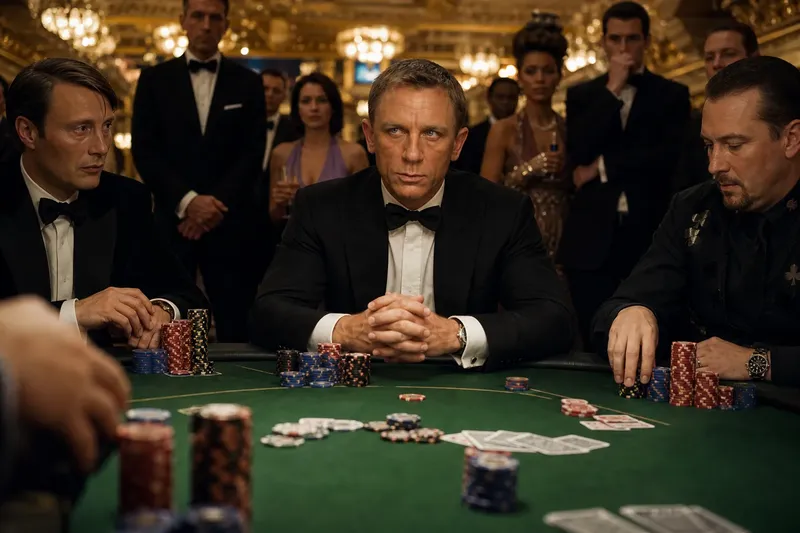
A green baize table fills the frame; a player’s face gives little away. In Casino Royale, casino images on screen turn a poker game into a contest over what can be seen and concealed. The scene offers a clear starting point for tracing how filmmakers build casino drama.
How did cinema frame the casino table?
Early screen portrayals often made gambling legible through a small set of visual cues: cards, chips, a close circle of players and the watcher at its edge. The table gave a scene a natural boundary. A director could keep the audience near a decision without explaining every rule of the game.
That enclosed view did not disappear as film styles changed. It remains useful because a close-up can make a glance or hesitation feel consequential. Filmmakers also use movement through rooms, cuts to spectators and views of the business surrounding the game.
What changes when the room enters the story?
In Casino Royale (2006), the tournament at the fictional Casino Royale in Montenegro centres on the poker table. The camera moves among players’ faces and decisions, keeping uncertainty close. The venue matters, but the scene’s tension comes chiefly from people trying to read one another.
Martin Scorsese’s Casino (1995) gives Las Vegas a broader role. The casino business, its public image and the labour behind its spectacle form part of the film’s subject. Its world is not conveyed by a grand room alone: the story also attends to the organisation that makes such a room appear effortless.
These films do not establish a neat historical march from private rooms to public floors. They show different emphases, made in different eras for different stories. A production can return to the intimate table at any time; spectacle does not replace it.
Which screen techniques create secrecy or spectacle?
Framing controls how much of a room the audience can read. A close shot of hands or faces withholds the surroundings; a wide shot places players among watchers, staff and architecture. Neither view is neutral. Each directs attention towards a particular kind of drama.
Editing can make a public space feel private. A cut from a crowded room to one player’s expression narrows the scene to a single reaction. Sound can do the reverse: conversation, music or the clatter of chips may make a close encounter feel exposed to everyone nearby.
Mirrors and glass offer another complication. They can place an observer behind a character, divide a face from its setting, or make a room seem larger than the camera has shown. These devices describe cinematic choices, not a dependable record of a venue’s layout.
Notice who gets to look, and who is being watched.
Why do casino scenes keep returning to the table?
A table concentrates conflict. Players face one another, rules limit their choices, and small gestures can carry more weight than a crowd scene. For a filmmaker, it is an efficient stage: the audience can follow the stakes through reactions even when it knows little about the game.
The wider venue serves a different purpose. It can make a character seem powerful, out of place or swallowed by a system. In Casino, the business around the gambling helps show that spectacle depends on management and work, not merely decorative lights. The room is part of the story’s machinery.
These approaches can sit in the same film. A wide view may establish scale, then a close shot can narrow the question to one decision. The shift of attention from room to player tells us how the film wants us to read that moment.
What do viewers ask about casino scenes?
Does a casino scene show a real venue?
Not necessarily. Productions may use sets, altered locations or combined visual references, so the image alone cannot identify a real place. Check reliable production information if the filming location matters.
Why do directors use close-ups at a gaming table?
Close-ups focus attention on expressions, hands and pauses, making concealed information part of the drama. They can also leave the room’s scale deliberately unclear.
How does a wide shot change the scene?
A wide shot shows the table in relation to its surroundings and can present the venue as a public spectacle. It may also make one character appear small within a larger institution.
Does a crowded screen portray everyday casino life?
It portrays a crowd assembled and framed for that scene. Casting, camera placement and editing shape the impression, so the image should not be treated as an account of ordinary activity.
How can you read casino images on screen closely?
Separate the visible technique from the story’s claims. Note the camera’s distance, the sounds that remain, who is shown watching and what the edit leaves out. Then ask what effect those choices produce: privacy, pressure, status or scale.
Check whether the camera stays on faces and hands. If it does, read the scene as focused on individual decisions; if it does not, consider how the wider setting shapes the action.
Check whether the edit shows spectators. If it does, consider public scrutiny; if it does not, treat the encounter as deliberately contained.
Check whether sound emphasises conversation or general room noise. If voices are isolated, note intimacy; if they are not, consider how the crowd contributes to spectacle.
Check whether mirrors or glass reveal another viewpoint. If they do, ask who is watching; if they do not, avoid assuming the scene has established an unseen observer.
Check whether staff and operations appear. If they do, consider how the film presents the venue as a workplace; if they do not, note that the story may be showing only the polished floor.
Check whether the scene cuts from a wide view to a close one. If it does, track the shift from scale to personal stakes; if it does not, consider what the sustained viewpoint keeps in focus.
Say you are watching an invented casino scene that opens with a wide view of a busy floor, then cuts to two players and silences the surrounding chatter. Start by noting the crowd and room: the opening establishes public scale. Then track the cut and sound change: the tight framing and muted background direct attention towards a private contest. The resulting reading is that the film uses the room to establish scale before narrowing the drama to concealed intentions. Neither shot tells you how an actual venue operates.
Casino images on screen are most revealing when read as choices of framing, sound and emphasis. That approach makes comparisons between films more precise, while keeping the analysis focused on the work of cinema rather than on claims about real places.