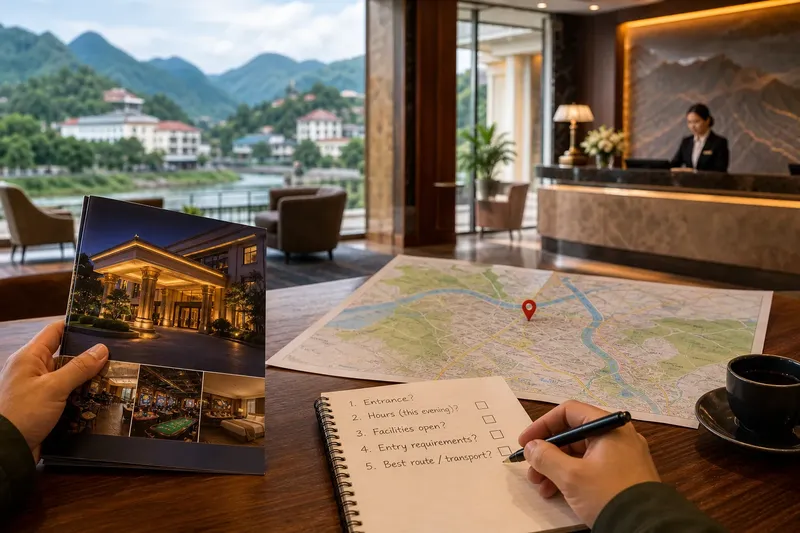
Casino or Resort? Reading the Label in Context
Casino or resort labels stress different parts of a place. Learn how to read the wording alongside location, facilities and local context before deciding what it means.
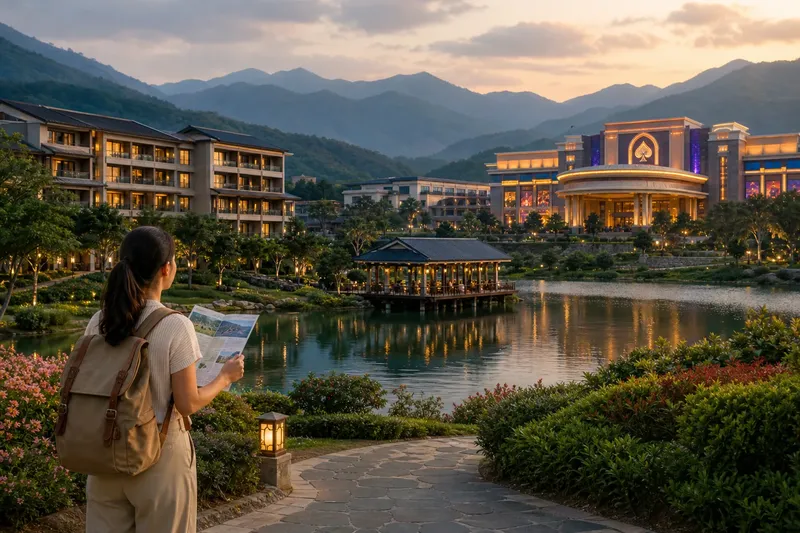
On a roadside sign near Yên Bái, the word “resort” might sit above a photograph of a lake; a casino listing elsewhere may lead with gaming. Casino or resort labels direct attention towards different parts of a place, but neither tells you by itself what a visitor will find, how the site operates or what it means locally. The useful question is not which label is correct in the abstract. It is what the label is doing in this particular context.
What does each label put first?
“Casino” names a gambling venue or a venue whose identity is closely associated with gambling. In public language, it brings gaming to the foreground: tables, machines, entry conditions and the particular rules that govern play. It can also carry associations of nightlife, risk and spectacle, even when the place has other facilities.
“Resort” usually presents a broader stay or leisure destination. The word may suggest accommodation, food, recreation, a landscaped setting or several services gathered in one place. It is a framing term, not a complete inventory. Some resorts are quiet and nature-oriented; others are built around entertainment, gaming or events.
The distinction is one of emphasis, not a reliable dividing line between two sealed types of property. A site can include lodging and restaurants alongside gaming. Calling it a casino may highlight one activity; calling it a resort may draw attention to the wider visitor offer. Neither description necessarily cancels the other.
When a label seems decisive, ask what it leaves out.
Why does the same place get both names?
Different speakers have different reasons for choosing a word. A visitor searching for gambling facilities may use “casino” because it is the clearest term for that purpose. A tourism listing may prefer “resort” because it groups accommodation, dining and recreation under a broader destination idea. A local resident might use a familiar place name instead of either category.
Those choices affect the picture readers form. “Casino” can make a multi-service property sound like a single-purpose venue. “Resort” can make gaming seem incidental, even if it is a central part of the operation or the site’s public identity. The wording may also reflect the intended audience: a gaming-focused description speaks to one set of interests, while a destination description addresses visitors considering a wider itinerary.
Language also travels. A phrase used in an English-language listing may not match how local people describe a site in Vietnamese, or how an official category is rendered in translation. That does not automatically make one version misleading. It means the words belong to particular settings and audiences, and should be read as descriptions rather than as complete definitions.
Which description suits which reader?
For someone deciding whether a place offers gaming, “casino” is the more direct starting point. It names the activity to investigate and helps identify questions about access, eligibility and the kinds of games available. It does not establish that a particular visitor can enter or take part.
For a traveller comparing places to stay, “resort” may be the more useful first filter. It suggests that lodging or leisure facilities deserve attention, but it does not establish that rooms are available, that facilities suit a particular trip or that gaming is absent. A family looking for a quiet stay and a group seeking evening entertainment can both encounter the word, with different expectations.
For local readers, journalists and anyone considering a place’s public role, neither term is enough. The relevant questions may concern where the site sits, what activities take place there, how it relates to nearby communities and which people use it. A label can orient that discussion, but it cannot settle it.
Choose the word that matches your question, then look for evidence that answers the question itself.
What should you check beyond casino or resort?
- Location: Is the site in Yên Bái, elsewhere in the region or simply described with a local place name? Check the actual location rather than assuming the label identifies it.
- Facilities: Are accommodation, dining, recreation or gaming expressly described? Treat a broad category as an invitation to check the individual services.
- Audience: Is the wording aimed at players, overnight guests, event visitors or a general tourism audience? The intended reader often explains what the description foregrounds.
- Access: Does the information explain who may enter and under what conditions? A venue’s name does not answer eligibility questions.
- Local terminology: Is the English wording a translation, a commercial label or a term used by local sources? These may carry different shades of meaning.
- Scope: Does the description cover the whole property or just one part of it? A casino within a larger site is not necessarily the site’s only function.
Descriptions can vary across signs, listings and conversations. Where the answer depends on a licence, entry rule or operating condition, rely on the relevant official information and the venue’s stated terms, rather than inferring it from the name.
How can you choose a useful reading?
Start with the reason you are reading the description. If you want to know whether gaming is part of the offer, search the property’s stated activities. If you are assessing it as a destination, look for the specific accommodation and leisure facilities. If you are writing about its place in public life, name the activity or relationship at issue rather than allowing one broad label to stand in for the whole site.
Say you are planning a visit near Yên Bái and a listing calls a property a resort. You want to know whether it is relevant to an evening out rather than simply a place to sleep. Check the listing for named activities and access information; if it mentions lodging and restaurants but says nothing about gaming, the sensible conclusion is that the label alone has not answered your question. You would then seek a more specific description, not assume that the resort is or is not a casino.
This approach also helps when two descriptions appear to conflict. Compare what each claims, not just the nouns. One may describe the whole site and another a particular facility. One may be promotional language and another a local shorthand. If both are vague, keep the uncertainty visible instead of forcing them into a single tidy category.
What questions help distinguish the terms?
Does “resort” mean there is no casino?
No. The term describes a broader destination or leisure framing and does not rule out gaming facilities. Check the stated activities of the particular property.
Does “casino” mean the place is only for gambling?
No. It foregrounds gaming, but the site may also include accommodation, food or other services. The label does not list everything on offer.
Can one property accurately be called both?
Yes, if it has a wider visitor offer as well as a casino operation. The two words can describe different aspects of the same place rather than competing for a single correct slot.
Which term should a writer use?
Use the term that accurately fits the point being made, then specify the relevant facility or activity. If the scope is unclear, use the property’s name and describe what is known without treating a label as proof.
What does the label leave unsaid?
Both words compress a complicated place into a convenient category. That is useful for search and conversation, but compression hides distinctions: the scale of a site, the mix of activities, its local setting and the way visitors encounter it. The same name may mean something different to a traveller, a gaming customer and a neighbour.
Reading casino or resort in context means treating each as a clue about emphasis, not a verdict on character. For a place in or around Yên Bái, the most accurate account may need both terms, neither term, or a plain description of the facilities and setting. The label is a starting point; the details show what it can reasonably mean.